GridColoring
SRM 409 · 2008-07-10 · by slex
Problem Statement
Given a rectangular grid where all the cells are initially white, you perform the following procedure K times:
- Select a cell from the grid at random, and call it A
- Select a cell from the grid at random, and call it B
- Color all the cells in the rectangle bounded by A and B
For example, the image below shows a 5x7 grid where the selected pairs could have been (row, column):
- (0,1); (3,2)
- (3,6); (4,0)
- (0,6); (0,5)
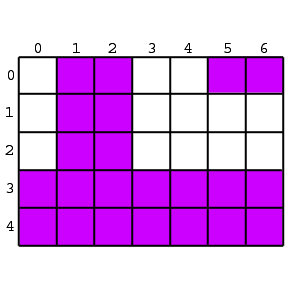
You are given
Notes
- The returned value must be accurate to within a relative or absolute value of 1E-9.
Constraints
- K will be between 0 and 100, inclusive.
- rows will be between 1 and 1000, inclusive.
- cols will be between 1 and 1000, inclusive.
Statement by TopCoder, Inc. — view the original on the archive.
1
2
1
Returns: 1.5
The grid has two cells. The probability that both of them will get colored is 0.5, and the probability that only one of them will get colored is 0.5. So the expected value is 0.5 * 2 + 0.5 * 1 = 1.5.
2
2
1
Returns: 1.875
With the same grid as in the previous example, but two selections, the expected value rises to 1.875.
1
2
2
Returns: 2.25
3
5
7
Returns: 19.11917924647044
0
1000
1000
Returns: 0.0
Submissions are judged against all 60 archived test cases, of which 5 are shown here. Case numbers match the judge’s.
Language: C++17 · define a public class GridColoring with a public method double area(int K, int rows, int cols) · 60 test cases · 2 s / 256 MB per case