BlackWhiteRectangles
TCO08 Qual 2 · 2008-01-21 · by ivan_metelsky
Problem Statement
NOTE: This problem statement contains images that may not display properly if viewed outside of the applet.
There is an infinite sheet of paper which is divided into 1x1 cells. A cartesian coordinate system exists on the sheet, with its origin at the corner of one of the cells. The X-axis goes from left to right in the positive direction and the Y-axis goes from bottom to top in the positive direction. The axes are parallel to the sides of the cells.
Initially, all the cells are white. You are given a
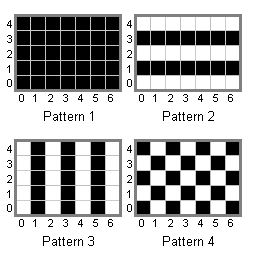
- Pattern 1: All cells are colored black.
- Pattern 2: All cells in odd-numbered rows are colored black (the rows of the rectangle are numbered from bottom to top, starting from 0).
- Pattern 3: All cells in odd-numbered columns are colored black (the columns of the rectangle are numbered from left to right, starting from 0).
- Pattern 4: All cells with row and column numbers that are either both odd or both even are colored black.
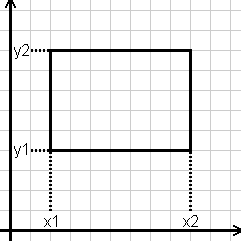
The pictures below illustrate a rectangle and all the possible patterns:
Return the total number of black cells on the sheet of paper after all the rectangles are drawn.
Constraints
- rectangles will contain between 1 and 50 elements, inclusive.
- Each element of rectangles will be formatted as "x1 y1 x2 y2 type" (quotes for clarity), where x1, y1, x2, y2 will each be an integer between 1 and 40000, inclusive, without leading zeros, and type will be an integer between 1 and 4, inclusive, without leading zeros.
- In each element of rectangles, x1 will be strictly less than x2, and y1 will be strictly less than y2.
Statement by TopCoder, Inc. — view the original on the archive.
{"1 1 6 8 1",
 "11 1 16 8 2",
 "1 11 6 18 3",
 "11 11 16 18 4"}
Returns: 82
Here we have 4 non-overlapping 5x7 rectangles with all possible filling patterns. Therefore the total number of black cells is 35 + 14 + 15 + 18 = 82.
{"1 1 11 11 1",
 "1 1 11 11 2",
 "9 9 19 19 3",
 "9 9 19 19 4"}
Returns: 172
In this case we have 2 equal 10x10 rectangles with filling patterns 1 and 2 (100 black cells) and 2 equal 10x10 rectangles with filling patterns 3 and 4 (75 black cells). Since the first two rectangles and the last two rectangles have 3 black cells in common, the result is 100 + 75 - 3 = 172.
{"1 6 9 9 1",
 "1 9 7 10 1",
 "1 5 8 7 1",
 "2 6 8 8 1",
 "2 1 3 4 1"}
Returns: 40
{"7 5 9 6 4",
 "6 3 9 6 4",
 "8 3 9 8 4",
 "5 9 10 10 4",
 "5 3 8 5 4"}
Returns: 13
{"7 1 10 3 1",
 "8 2 9 7 4",
 "5 3 7 4 3",
 "4 3 9 4 2",
 "3 1 9 2 1"}
Returns: 13
Submissions are judged against all 104 archived test cases, of which 5 are shown here. Case numbers match the judge’s.
Language: C++17 · define a public class BlackWhiteRectangles with a public method int blackCount(vector<string> rectangles) · 104 test cases · 2 s / 256 MB per case