DiagonalDisproportion
SRM 283 · 2006-01-19 · by gevak
Problem Statement
Note: this problem statement contains images that may not display properly if viewed outside the applet.
You are to calculate the diagonal disproportion of a square matrix. The diagonal disproportion of a square matrix is the sum of the elements of its main diagonal minus the sum of the elements of its collateral diagonal. The main and collateral diagonals of a square matrix are shown in figures 1 and 2 respectively.
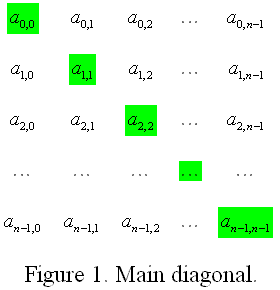
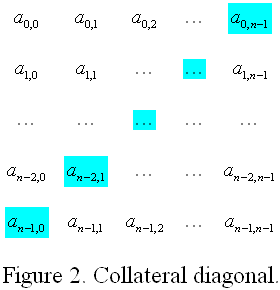
The elements of the main diagonal are shown in green in figure 1, and the elements of the collateral diagonal are shown in cyan in figure 2.
Given a
Constraints
- matrix will contain between 1 and 50 elements, inclusive.
- Each element of matrix will contain only digits ('0'-'9').
- The number of characters in each element of matrix will be equal to the number of elements in matrix.
Statement by TopCoder, Inc. — view the original on the archive.
{"190","828","373"}
Returns: 1
The sum of the elements of the main diagonal is 1+2+3 = 6. The sum of the elements of the collateral diagonal is 0+2+3 = 5. So, the answer is 6-5 = 1.
{"9000","0120","0000","9000"}
Returns: -1
{"6"}
Returns: 0
The matrix has only one element, and this element lies on both the main and collateral diagonals.
{"7748297018","8395414567","7006199788","5446757413","2972498628",
"0508396790","9986085827","2386063041","5687189519","7729785238"}
Returns: -24
{"123456","234567","345678","456789","567890","678901"}
Returns: -10
Submissions are judged against all 21 archived test cases, of which 5 are shown here. Case numbers match the judge’s.
Language: C++17 · define a public class DiagonalDisproportion with a public method int getDisproportion(vector<string> matrix) · 21 test cases · 2 s / 256 MB per case