TriangleRooks
TCO05 Wildcard · 2005-08-16 · by AdminBrett
TCO05 Wildcard · 2005-08-16 · by AdminBrett · Graph Theory
Problem Statement
Problem Statement
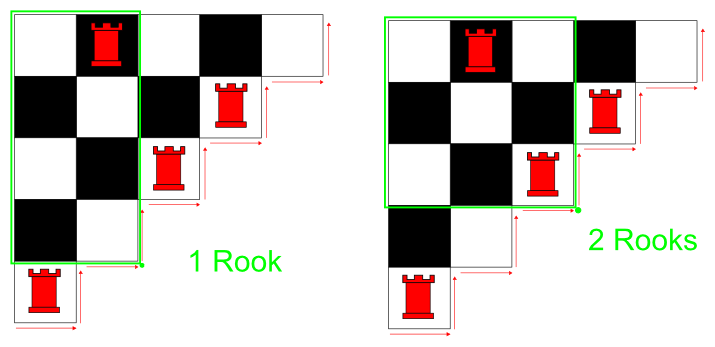
Suppose you have half of a chessboard as depicted below with 0 or more rooks placed on it. No two rooks can share a row or column.
Beginning with the lower left corner, we travel along the edge of the board. Below, the different positions we move through during this process are numbered.
Given a sequence of 2n+1 integers, you will return aString[] with n elements. Element k (0-based), which corresponds to row k of the board, will contain precisely n-k characters. 'R' should be used to denote a rook and '.' should be used to denote an empty square. If more than one board is possible, choose the one where the rook in row 0 is furthest to the left (if such a rook exists). If multiple boards are still possible, choose the one where the rook in row 1 is furthest to the left, and so forth. If no board is possible, return an empty String[] . The sequence will be given in seqBeg and seqEnd. The elements of seqBeg all come before the elements of seqEnd. For example, if
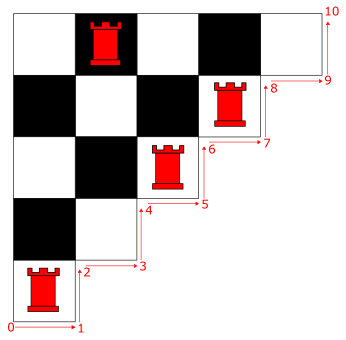
0, 1, 0, 1, 1, 2, 1, 2, 1, 1, 0.In this problem we reverse the process. Instead, you are given the sequence and must return the corresponding half-chessboard.
Given a sequence of 2n+1 integers, you will return a
seqBeg = { 0, 1, 0, 1, 1, 2, 1 }
seqEnd = { 2, 1, 1, 0}
then the resulting 11 element input sequence is the same as featured in the example above.Constraints
- seqBeg and seqEnd will contain between 0 and 50 elements inclusive.
- The combination of seqBeg and seqEnd will contain an odd number of elements.
- The combination of seqBeg and seqEnd will contain at least 3 elements.
- Each element of seqBeg and seqEnd will be between 0 and 100 inclusive.
Statement by TopCoder, Inc. — view the original on the archive.
Examples
0)
{ 0, 1, 0, 1, 1, 2, 1 }
{ 2, 1, 1, 0}
Returns: {".R...", "...R", "..R", "..", "R" }
From the problem statement.
1)
{0,2,2,3,2,2,1,1,0}
{}
Returns: { }
2)
{0, 0, 0}
{0, 0, 0, 0}
Returns: {"...", "..", "." }
3)
{0, 1, 0}
{}
Returns: {"R" }
4)
{0, 2, 0}
{}
Returns: { }
Submissions are judged against all 60 archived test cases, of which 5 are shown here. Case numbers match the judge’s.
Coding Area
Language: C++17 · define a public class TriangleRooks with a public method vector<string> getBoard(vector<int> seqBeg, vector<int> seqEnd) · 60 test cases · 2 s / 256 MB per case