RemoteRover
SRM 235 · 2005-03-22 · by the_one_smiley
Problem Statement
This problem statement contains an image.
You are responsible for planning the operation of a remote control rover that is exploring a distant planet. Your team of scientists has identified a target of interest, and they want the rover to reach it as soon as possible. The rover can change directions in a negligible amount of time, but its maximum speed is dependent on the terrain it is traversing. Consider a rectangle with the rover's initial position and the target at opposite corners (the target is close enough that the curvature of the planet's surface can be neglected), as displayed in the example below. The rectangle is divided into parallel strips of terrain with different widths, and each strip has its own limit on the maximum speed of the rover. Your goal is to find the route that will minimize the travel time to the target.
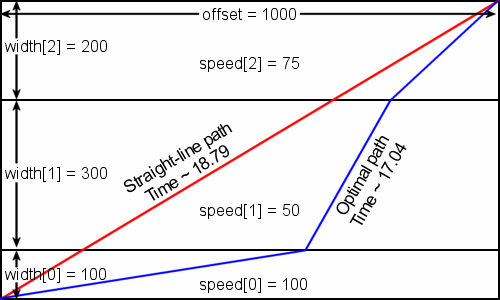
Example 0: The rover starts in the lower left corner and the target is in the upper right. Covering more horizontal distance in the thin strip where the maximum speed is high yields a shorter total travel time compared to the shortest-path time.
Write a class RemoteRover with a method optimalTravel that takes a
Notes
- A return value with either an absolute or relative error of less than 1e-9 is considered correct.
Constraints
- width will contain between 1 and 50 elements, inclusive.
- speed will contain between 1 and 50 elements, inclusive.
- width and speed will contain the same number of elements.
- Each element of width will be between 1 and 10000, inclusive.
- Each element of speed will be between 1 and 1000, inclusive.
- offset will be between 0 and 10000, inclusive.
Statement by TopCoder, Inc. — view the original on the archive.
{100, 300, 200}
{100, 50, 75}
1000
Returns: 17.042083785318038
The example from the problem statement.
{1155, 6184, 2783, 7540, 8156}
{570, 810, 875, 172, 642}
0
Returns: 69.38271426584203
An offset of 0 means the target is directly across the strips from the initial position, so there is no reason to deviate from a straight path.
{5000}
{50}
10000
Returns: 223.60679774997894
The shortest and quickest path here is a straight line to the target.
{9033, 8232, 8842, 6518, 2358, 1115, 941, 928, 220, 8460}
{50, 50, 50, 50, 50, 50, 50, 50, 50, 50}
10000
Returns: 954.1368054948935
The speed limits in each of the strips are identical, so they might as well be a single wide strip.
{9236, 7065, 2283, 506, 6432, 9812, 3133, 1397, 7052, 3729,
2556, 9954, 1367, 6440, 5141, 3091, 2879, 1346, 7080, 1036,
7503, 7775, 433, 7579, 6520, 2287, 1971, 3879, 1725, 8200,
1830, 2774, 3850, 7509, 8531, 7493, 1511, 9399, 9679, 2124,
791, 3432}
{956, 799, 481, 194, 993, 444, 571, 986, 815, 910,
98, 847, 650, 487, 419, 434, 410, 812, 374, 751,
307, 134, 134, 955, 758, 73, 932, 360, 135, 588,
218, 936, 674, 494, 157, 556, 881, 292, 851, 890,
886, 912}
9756
Returns: 501.6129192127166
Submissions are judged against all 57 archived test cases, of which 5 are shown here. Case numbers match the judge’s.
Language: C++17 · define a public class RemoteRover with a public method double optimalTravel(vector<int> width, vector<int> speed, int offset) · 57 test cases · 2 s / 256 MB per case