CheckerPolygon
TCCC05 Semi 3 · 2005-01-10 · by Yarin
Problem Statement
A convex polygon is placed on a large checkerboard with the polygon vertices lying on the grid intersections. Calculate the number of light and dark squares lying entirely inside the polygon. Assume that the polygon edges are infinitely thin. In the picture below, 28 light squares and 26 dark squares are enclosed by the polygon. The upper left corner (coordinates 0,0) will always be a dark square.
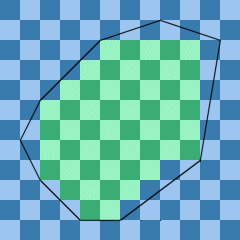
Create a class CheckerPolygon containing the method countSquares which takes two
Notes
- The vertices in the polygon may be ordered clockwise or counter-clockwise.
Constraints
- X and Y will contain between 3 and 50 elements, inclusive.
- X will contain the same number of elements as Y.
- Each element in X and Y will be between 0 and 10000, inclusive.
- The polygon described by X and Y will be convex.
- There will not be three points lying on the same line.
Statement by TopCoder, Inc. — view the original on the archive.
{1,2,5,8,11,10,6,4,2}
{7,5,2,1,2,8,11,11,9}
Returns: {26, 28 }
This is the example in the problem statement.
{1,5000,5001,10000,10000,5001,5000,1}
{4999,0,0,4999,5000,9999,9999,5000}
Returns: {25000000, 24990001 }
{1,3,6}
{3,6,1}
Returns: {1, 1 }
{537,127,987,2390}
{173,98,12,107}
Returns: {90908, 90911 }
{10000,10000,0,0}
{0,10000,10000,0}
Returns: {50000000, 50000000 }
Submissions are judged against all 59 archived test cases, of which 5 are shown here. Case numbers match the judge’s.
Language: C++17 · define a public class CheckerPolygon with a public method vector<int> countSquares(vector<int> X, vector<int> Y) · 59 test cases · 2 s / 256 MB per case