Fences
TCCC '04 Round 3 · 2004-02-23 · by Yarin
Problem Statement
Farmer John has several pastures, each of which can be described as several overlapping and/or touching rectangles. For instance, the pasture in the picture below can be considered as the union of the rectangles (2,2)-(10,5) and (7,1)-(9,7). Two rectangles that only touch each other in a corner aren't counted as touching or overlapping rectangles, see example 4.
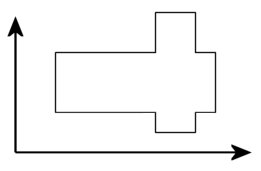
Farmer John wants to enclose all his pastures with fences (one fence for each pasture). Help him find out the total length of all fences if all the borderlines must be fenced (see example 2).
Create a class Fences containing the method fenceLength that takes a
Constraints
- x1, y1, x2 and y2 will contain between 1 and 50 elements, inclusive.
- x1, y1, x2 and y2 will all contain the same number of elements.
- Each element in x1, y1, x2 and y2 will be between 0 and 1000, inclusive.
- Element i in x1 will differ from element i in x2.
- Element i in y1 will differ from element i in y2.
Statement by TopCoder, Inc. — view the original on the archive.
{0,3,5,15}
{0,3,7,4}
{7,5,10,20}
{5,8,9,8}
Returns: 60
Here we have four rectangles that together describes two pastures, as rectangles 0 and 1 intersect and rectangles 1 and 2 touch each other.
{100,80}
{200,230}
{50,90}
{250,205}
Returns: 200
x2 and y2 might be greater than x1 and y1.
{10,30,20,10}
{10,10,10,40}
{20,40,40,30}
{40,40,20,30}
Returns: 160
These four rectangles form a single pasture with a hole in the middle. Since there must be fences along the borders, there must both be an "outer" fence (length 120) and an "inner" fence (length 40).
{976,823,228,463,702,515,690,252,153,
 525,260,356,435,369,942, 59,605,173,
 178, 70,420, 40,705, 38,841,430,965,
 312,680,188,982,160,395,219,340,225}
{314,759, 67,232,815,882,211,839, 48,
 531,567,803,439,418,968, 74, 88,834,
 806,920,920,194,602,436,624,331,314,
  68,421,659,653, 99,921,339,865,408}
{835,794,980, 90,808,649,198,334,309,
 749,187,965,578,199,655,273,503,489,
 167,996,212,355, 34,430,749,527,109,
 501,380, 36,641,872, 47,157,433, 85}
{306,421,283,413,466,747,882,297,790,
 576,695,102,655,121, 82,400, 36,236,
 143,108,862,400,357,386,790,732,  4,
 800,316,166,239,242,121, 57,111, 85}
Returns: 3854
{0,0,0,0,0,0,0,0,0,0,0,0,0,0,0,0,0,0,0,0,0,0,0,0,0,0,0,0,0,0,0,0,0,0,0,0,0,0,0,0,0,0,0,0,0,0,0,0,0,0}
{0,0,0,0,0,0,0,0,0,0,0,0,0,0,0,0,0,0,0,0,0,0,0,0,0,0,0,0,0,0,0,0,0,0,0,0,0,0,0,0,0,0,0,0,0,0,0,0,0,0}
{1000,1000,1000,1000,1000,1000,1000,1000,1000,1000,1000,1000,1000,1000,1000,1000,1000,1000,1000,1000,1000,1000,1000,1000,1000,1000,1000,1000,1000,1000,1000,1000,1000,1000,1000,1000,1000,1000,1000,1000,1000,1000,1000,1000,1000,1000,1000,1000,1000,1000}
{1000,1000,1000,1000,1000,1000,1000,1000,1000,1000,1000,1000,1000,1000,1000,1000,1000,1000,1000,1000,1000,1000,1000,1000,1000,1000,1000,1000,1000,1000,1000,1000,1000,1000,1000,1000,1000,1000,1000,1000,1000,1000,1000,1000,1000,1000,1000,1000,1000,1000}
Returns: 4000
{1,5}
{1,5}
{5,10}
{5,10}
Returns: 36
The two rectangles only touch each other at one corner, and are thus considered as different pastures.
Submissions are judged against all 57 archived test cases, of which 6 are shown here. Case numbers match the judge’s.
Language: C++17 · define a public class Fences with a public method int fenceLength(vector<int> x1, vector<int> y1, vector<int> x2, vector<int> y2) · 57 test cases · 2 s / 256 MB per case