AvoidRoads
TCO '03 Semifinals 4 · 2003-10-07 · by brett1479
TCO '03 Semifinals 4 · 2003-10-07 · by brett1479 · Dynamic Programming
Problem Statement
Problem Statement
Problem contains images. Plugin users can view them in the applet.
In the city, roads are arranged in a grid pattern. Each point on the grid represents a corner where two blocks meet. The points are connected by line segments which represent the various street blocks. Using the cartesian coordinate system, we can assign a pair of integers to each corner as shown below.
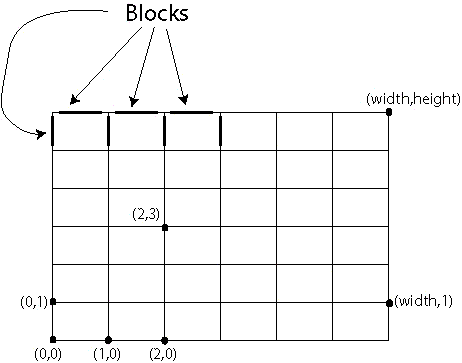
You are standing at the corner with coordinates 0,0. Your destination is at corner width,height. You will return the number of distinct paths that lead to your destination. Each path must use exactly width+height blocks. In addition, the city has declared certain street blocks untraversable. These blocks may not be a part of any path. You will be given aString[] bad describing which blocks are bad. If (quotes for clarity) "a b c d" is an element of bad, it means the block from corner a,b to corner c,d is untraversable. For example, let's say
In the city, roads are arranged in a grid pattern. Each point on the grid represents a corner where two blocks meet. The points are connected by line segments which represent the various street blocks. Using the cartesian coordinate system, we can assign a pair of integers to each corner as shown below.
You are standing at the corner with coordinates 0,0. Your destination is at corner width,height. You will return the number of distinct paths that lead to your destination. Each path must use exactly width+height blocks. In addition, the city has declared certain street blocks untraversable. These blocks may not be a part of any path. You will be given a
width  = 6
length = 6
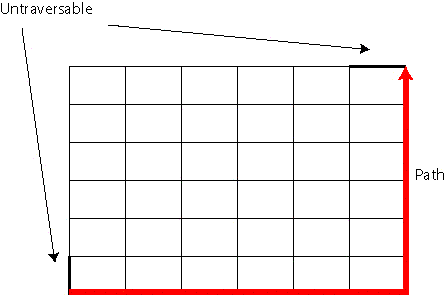
bad = {"0 0 0 1","6 6 5 6"}
The picture below shows the grid, with untraversable blocks darkened in black. A sample path has been highlighted in red.
Constraints
- width will be between 1 and 100 inclusive.
- height will be between 1 and 100 inclusive.
- bad will contain between 0 and 50 elements inclusive.
- Each element of bad will contain between 7 and 14 characters inclusive.
- Each element of the bad will be in the format "a b c d" where, a,b,c,d are integers with no extra leading zeros, a and c are between 0 and width inclusive, b and d are between 0 and height inclusive,and a,b is one block away from c,d.
- The return value will be between 0 and 2^63-1 inclusive.
Statement by TopCoder, Inc. — view the original on the archive.
Examples
0)
6
6
{"0 0 0 1","6 6 5 6"}
Returns: 252
Example from above.
1)
1
1
{}
Returns: 2
Four blocks aranged in a square. Only 2 paths allowed.
2)
100
100
{"0 0 0 1","0 0 1 0","0 1 0 0"}
Returns: 0
Both paths out of 0,0 are untraversable. Note that there can be repeated bad blocks.
3)
35
31
{}
Returns: 6406484391866534976
Big number.
4)
2
100
{}
Returns: 5151
Submissions are judged against all 92 archived test cases, of which 5 are shown here. Case numbers match the judge’s.
Coding Area
Language: C++17 · define a public class AvoidRoads with a public method long long numWays(int width, int height, vector<string> bad) · 92 test cases · 2 s / 256 MB per case