PiecewiseLinearFunction
SRM 586 · 2013-06-25 · by gojira_tc
Problem Statement
As another example, this is the plot of the function F for Y = {1, 4, -1, 2}.
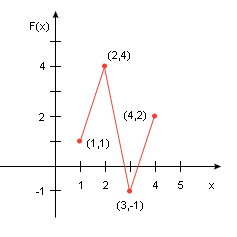
Given a real number y, we can count the number of solutions to the equation F(x)=y. For example, for the function plotted above there are 0 solutions for y=7, there is 1 solution for y=4, and there are 3 solutions for y=1.1. We are looking for the largest number of solutions such an equation can have. For the function plotted above the answer would be 3: there is no y such that F(x)=y has more than 3 solutions.
If there is an y such that the equation F(x)=y has infinitely many solutions, return -1. Otherwise, return the maximum possible number of solutions such an equation may have.
Constraints
- Y will contain between 2 and 50 elements, inclusive.
- Each element of Y will be between -1,000,000,000 and 1,000,000,000, inclusive.
Statement by TopCoder, Inc. — view the original on the archive.
{3, 2}
Returns: 1
The graph of this function is a line segment between (1, 3) and (2, 2). For any y such that 2 ≤ y ≤ 3 the equation F(x)=y has 1 solution, and for any other y it has 0 solutions.
{4, 4}
Returns: -1
The function's plot is a horizontal line segment between points (1, 4) and (2, 4). For y=4, F(x)=y has infinitely many solutions.
{1, 4, -1, 2}
Returns: 3
This is the example from the problem statement. Three solutions are obtained for any value of y between 1 and 2, inclusive:
{2, 1, 2, 1, 3, 2, 3, 2}
Returns: 5
{125612666, -991004227, 0, 6, 88023, -1000000000, 1000000000, -1000000000, 1000000000}
Returns: 6
Submissions are judged against all 165 archived test cases, of which 5 are shown here. Case numbers match the judge’s.
Language: C++17 · define a public class PiecewiseLinearFunction with a public method int maximumSolutions(vector<int> Y) · 165 test cases · 2 s / 256 MB per case