LineSegments
TCO10 Round 4 · 2010-04-11 · by keshav_57
Problem Statement
You are given the coordinates of N points on the 2-dimensional plane. No two points are coincident and no three are collinear. Find the number of pairs of intersecting line segments whose endpoints are among the given points. The line segments within each pair must not share any common endpoints.
For example, if the given points are {(1, 4), (2, 1), (0, 0), (1, 3) and (2, 4)}, then there are three valid pairs of intersecting line segments as shown in the pictures below.
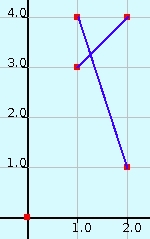
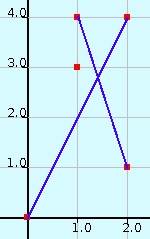
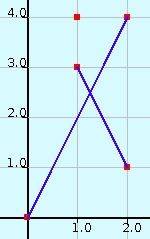
The king wants you to write a program to solve the above problem so that the answer given by the prince can be checked. The rth point is (xr, yr). The x-coordinates of the points can be generated by using the following recursive definition:
	x1 = xFirst, and
	xi = (xi-1*xProd + xAdd) mod xMod, for 2 ≤ i ≤ N
        (Note that (xi-1*xProd + xAdd) may overflow 32-bit integers)
The values of yr are defined similarly using yFirst, yAdd, yProd and yMod.Constraints
- N will be between 2 and 1200, inclusive.
- xMod and yMod will be between 1 and 1000000, inclusive.
- xFirst, xAdd and xProd will be between 0 and (xMod-1), inclusive.
- yFirst, yAdd and yProd will be between 0 and (yMod-1), inclusive.
- The values of the arguments will be such that among the N generated points (using the above definition), no two points will be coincident and no three will be collinear.
Statement by TopCoder, Inc. — view the original on the archive.
6
101080
5500
396324
412247
58495
46559
1680
81684
Returns: 10
5
88874
396279
597237
880235
258031
214893
320708
930580
Returns: 3
9
267352
11896
307137
447945
375427
194282
41875
490478
Returns: 80
7
217366
166352
213623
304880
418434
343792
355233
554631
Returns: 25
2
286304
478063
335016
606832
186861
55432
200484
233630
Returns: 0
4
4
3
1
5
1
1
1
3
Returns: 0
The points are (4, 1), (2, 2), (0, 0) and (3, 1). No intersecting line segments.
4
1
2
1
3
1
1
1
2
Returns: 1
The points are (1, 1), (0, 0), (2, 1) and (1, 0). Line segment {(0, 0), (2, 1)} intersects with line segment {(1, 1), (1, 0)}.
5
1
1
1
3
4
3
2
5
Returns: 3
The example in the problem statement.
6
215657
553897
915611
930784
193666
323425
130393
654599
Returns: 15
Make sure you take care of overflow.
Submissions are judged against all 128 archived test cases, of which 9 are shown here. Case numbers match the judge’s.
Language: C++17 · define a public class LineSegments with a public method long long intersections(int N, int xFirst, int xAdd, int xProd, int xMod, int yFirst, int yAdd, int yProd, int yMod) · 128 test cases · 2 s / 256 MB per case