CellRemoval
SRM 435 · 2009-02-12 · by almelv
SRM 435 · 2009-02-12 · by almelv · Graph Theory, Simple Search, Iteration
Problem Statement
Problem Statement
In biology, organisms have the following property: Starting from the first cell (the zygote), each cell during an organism's development process either divides into 2 other cells or does not divide at all. An organism is mature when all of its cells will not divide any further.
Let's assign a unique number to each cell in an organism's development process. For example, consider a species in which each organism starts with cell 0, which divides into cells 1 and 2. Cell 1 divides into cells 3 and 4. Cells 2, 3 and 4 do not divide. Every mature organism of this species will consist of exactly 3 cells - 2, 3 and 4.
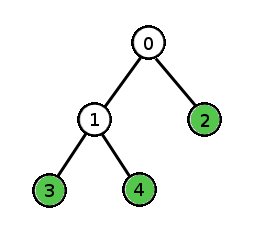
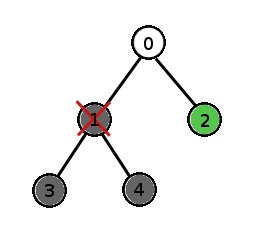
During the development process, if we kill a cell, it will be absent in the mature form of the organism. If that cell happens to be a cell that divides, then the mature organism will be missing all of the cell's descendants as well because the cell is killed before it has a chance to divide. For example, in the organism described above, if we kill cell 1 during the development process, the mature organism will contain only cell 2.
You are given aint[] parentCell describing the development process of an organism. The i-th element of parentCell is the parent cell of cell i (where i is a 0-based index). The zygote's parent is -1. Return the number of cells the mature form of this organism would have if you killed cell deletedCell during the development process.
Let's assign a unique number to each cell in an organism's development process. For example, consider a species in which each organism starts with cell 0, which divides into cells 1 and 2. Cell 1 divides into cells 3 and 4. Cells 2, 3 and 4 do not divide. Every mature organism of this species will consist of exactly 3 cells - 2, 3 and 4.
During the development process, if we kill a cell, it will be absent in the mature form of the organism. If that cell happens to be a cell that divides, then the mature organism will be missing all of the cell's descendants as well because the cell is killed before it has a chance to divide. For example, in the organism described above, if we kill cell 1 during the development process, the mature organism will contain only cell 2.
You are given a
Constraints
- parentCell will contain exactly N elements, where N is an odd integer between 1 and 50, inclusive.
- There will be exactly one "-1" element in parentCell.
- Every element of parentCell will be between -1 and N-1, inclusive.
- parentCell will form a binary tree.
- deletedCell will be between 0 and N-1, inclusive.
Statement by TopCoder, Inc. — view the original on the archive.
Examples
0)
{-1}
0
Returns: 0
1)
{-1,0,0}
0
Returns: 0
2)
{-1,0,0}
1
Returns: 1
3)
{1,-1,1}
2
Returns: 1
4)
{2,2,-1}
2
Returns: 0
5)
{-1,0,0,1,1}
2
Returns: 2
This is the example organism from the problem statement. If we kill cell 2, there will still be two cells left (3 and 4).
6)
{-1,0,0,1,1}
1
Returns: 1
This is the example organism from the problem statement. If we kill cell 1, the only cell left will be cell 2. Cells 3 and 4 will not exist because cell 1 is their ancestor.
7)
{-1,0,0,1,1}
0
Returns: 0
If we kill the zygote, there is nothing left.
Submissions are judged against all 125 archived test cases, of which 8 are shown here. Case numbers match the judge’s.
Coding Area
Language: C++17 · define a public class CellRemoval with a public method int cellsLeft(vector<int> parent, int deletedCell) · 125 test cases · 2 s / 256 MB per case